Synthetic Biology
Nature manufactures its materials under life-friendly conditions: in water, at room temperature, without harsh chemicals or high pressures.Janine Benyus, Biomimicry: Innovation Inspired by Nature (HarperCollins, 2009)
Synthetic Biology is the practice of redesigning living organisms to imbue them with novel traits and functions. The potential applications are numerous, but one common goal is to create less ecologically impactful systems to manufacture existing products. I was fortunate to work on one of these projects during my career at Ginkgo Bioworks and I hope to continue applying the techniques I developed there to other projects in the future.
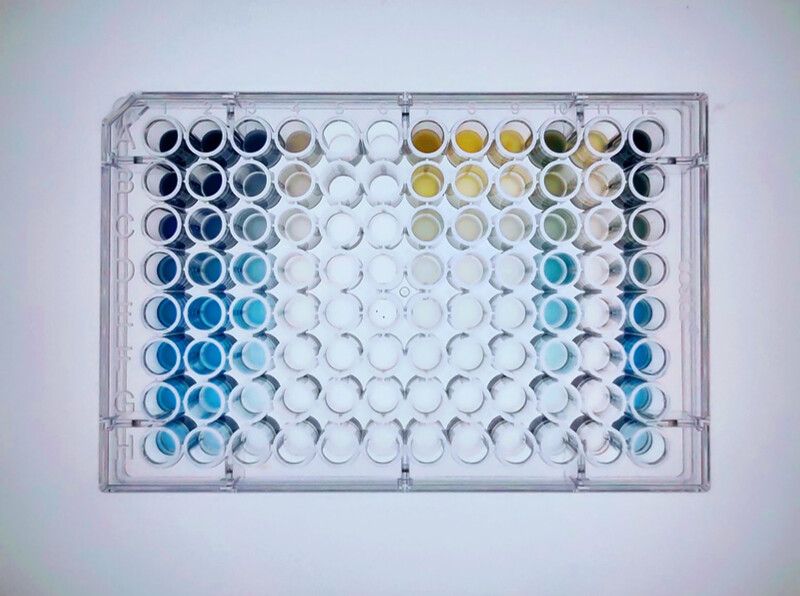
Metabolic engineering is akin to alchemy, by adding genes naturally found in Indigo plants to produce key enzymes we manipulate the most basic pathways to turn a simple and abundant sugar, glucose, into a sought after end product.
Indigo, the dye responsible for the characteristic hue of blue jeans and other garments, is naturally derived from various types of indigo plant and is one of the oldest and most widely used dyes in the world. Indican, the target product of this project, is a colorless and water soluble natural precursor to Indigo.
The goal of this project was to deliver a strain of E. coli to our clients which could produce Indican at commercially viable titers. Along with my manager, David Bauwens, I was part of the two person team assigned to the project.
- Designed combinatorial plasmid libraries to screen for top indican / indigo producers.
- Wrote software to operate robots and analyze data, identifying the top producers.
- Synthesized and assayed strain libraries of 1,000 to 2,000 samples each on automated liquid-handling work cells.
- Led strain and genetic-parts database curation: 10,000+ strain replicates, 1,000 DNA constructs.
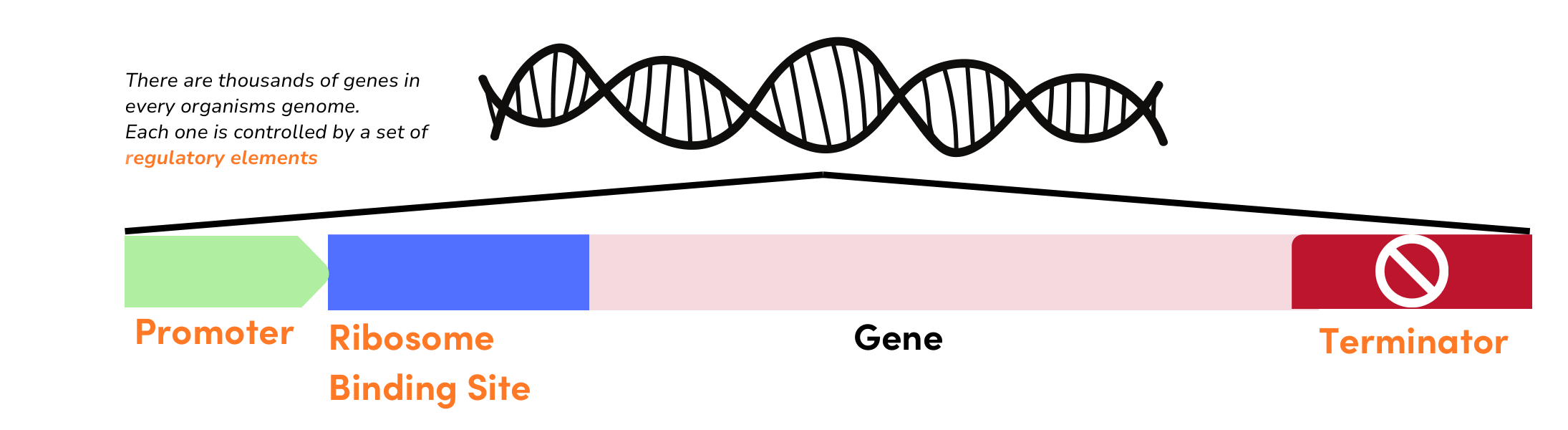
We explore the Bacteroides genome to manipulate its metabolism. We then use Bacteroides to manipulate our own.
I used the high-throughput techniques I developed for the Indican project for this project, with another client.
Research has linked the makeup of the human microbiome to numerous health outcomes, including curing infection, improving vaccine response, and more. Manipulating bacteria in the Bacteroides genus is a potential route to develop therapeutic probiotics.
Bacteroides are what is known as a "non-model organism" though; that is, relatively little is known about their genome or metabolism. Attempting to engineer them is like working on a car without the owner's manual or parts list.
The goal was to identify regulatory elements, the genetic sequences which control whether genes are turned on or off, so that our partners at Persephone could begin to engineer new probiotics.
- Characterized hundreds of novel regulatory elements in Bacteroides using luciferase-based screens.
- Delivered sets of 5 functional promoters, RBSs, and terminators to the customer.
- Screened libraries of 500 to 1,000 samples to assess regulatory-element strength.
- Planned autonomous growth and preparation of hundreds of strains with liquid handlers in anaerobic conditions.
- Built Dockerized tools that improved reproducibility; delivered the project two months ahead of schedule.
Software & Data Infrastructure
I started at Ginkgo Bioworks as a wet lab research associate but I quickly realized that by focusing on the workflows and software underlying my experiments I could both improve my own output as well as that of everyone I worked with.
Through teaching myself Python and learning how our in house automation worked, I developed scripts, and automation protocols to scale up experiments and reduce error. My first big implementation was on a project to develop a strain of E. coli to produce indigo dye at scale. Through leveraging automation I created methods to build and screen hundreds of strains and thousands of samples in parallel to identify top indigo producers.
I applied this methodology to a second project to identify uncharacterized regulatory elements in Bacteroides, a non-model anaerobic organism. By reusing codebase and techniques I developed prior we were able to deliver results to our customer months ahead of schedule.
I then transferred to a Yeast genome engineering project for a major pharmaceutical partner where I coordinated between software and wet lab teams to build new databases and dashboards to support a massive parallel genome engineering pipeline. From this project I transitioned to a software engineering role to focus specifically on meta-projects to enable lab scientists to work at higher throughputs.
Throughout all these projects I developed a set of personal design principles that I use to guide my work:
- No Mistake should be made more than once
- Build for the Next User
- Start Slow to move fast
With these in mind I always try to focus on quality and thoroughness up front which will lead to speed and efficiency down the line.
Recently with the emergence of tools like Claude Code I’ve found that I can work exponentially faster than before. I’ve been exploring development frameworks using these tools and have been developing a few AI enabled data exploration projects which I invite you to explore in my gitlab.
- Built Snowflake SQL databases to manage 10,000+ strain datasets, with a custom Python client for database interactions.
- Designed a project-tracking dashboard in Tibco Spotfire that cut decision-making time by 70%.
- Prototyped LIMS improvements for strain and DNA-molecule lineage tracking, enabling 2x faster decisions.
- Built sequence-analysis pipelines with Biopython and automated workflows with Snakemake and Airflow, generating modified genome models 10x faster.
- Managed Python package development and releases in GitLab; added JavaScript features to Django apps used by hundreds of people across the company.
- Earlier: developed NGS pipelines and SQL LIMS utilities (90% faster common protocols), applied PCA to visualize mutational variation across 1,000+ strains, and operated Hamilton Starplus and Echo 550 liquid-handling robots.
Earlier Research
- Klavins Lab, Undergraduate Research Assistant to Dr. Orlando De Lange: added data capture and analytics to Arabidopsis thaliana protoplast workflows (50% efficiency gain on key reactions); prepared RNA-seq experiments for Spirodela polyrhiza.
- DAWGMA undergraduate synthetic-biology research group, Team Lead: high-throughput characterization of plant metabolic pathways via MYC-JAZ binding; secured $2,337 in prototype funding for yeast biosensors and pitched at the Alaska Airlines Environmental Innovation Challenge.
- UW BioFab, Laboratory Technician: 300+ hours of standard synthetic-biology protocols.
- UW iGEM 2017: led integration of the violacein pathway into yeast for the Chromastat real-time metabolics tracker; presented at the iGEM Giant Jamboree in Boston.
Skills
Laboratory: sterile technique, PCR, gel electrophoresis, yeast and E. coli culture, transformation and transfection, plant protoplasting, DNA extraction, primer and oligo design, cytometry, RNA-seq prep.
Computational: Python, R, Ruby on Rails; Biopython, Snakemake, Airflow, Snowflake SQL, Tibco Spotfire.